有關腸桿菌科( Enterobacteriaceae )的特性敘述,下列何者最不適當?
詳細解析
本題觀念:
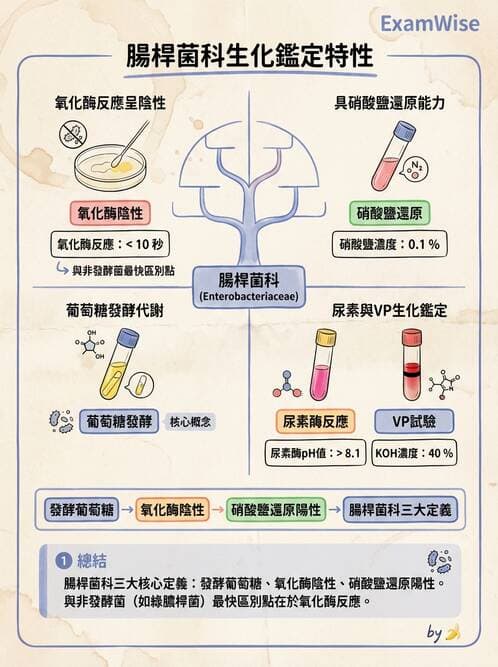
鑑別腸桿菌科(Enterobacteriaceae)常用一系列生化試驗,包括氧化酶(oxidase)、硝酸還原(nitrate reduction)、Voges–Proskauer(VP)及尿素酶(urease)等,以區分腸桿菌與其他革蘭氏陰性桿菌。
選項分析
-
選項A
Voges–Proskauer 測試是檢驗細菌在2,3-butanediol發酵路徑中,將丙酮酸鹽中間產物 acetoin 轉化為二羰基化合物(diacetyl),再與 α-萘酚及 KOH 顯色,呈粉紅紅色,通用於鑑別 VP 陽性的 Enterobacter、Klebsiella 等屬 (en.wikipedia.org)。敘述正確。 -
選項B
腸桿菌科普遍缺乏 cytochrome c oxidase,oxidase 試驗以 tetramethyl-p-phenylenediamine 作為底物,若無此酵素則不會氧化成深藍至紫色,故稱 oxidase-negative (sciencedirect.com)。敘述正確。 -
選項C
Enterobacteriaceae 幾乎全數具有 nitrate reductase,可將硝酸鹽(NO₃⁻)一步還原為亞硝酸鹽(NO₂⁻),此特性常用於鑑別〈Enterobacteriaceae〉與其他非發酵型革蘭氏陰性桿菌 (asm.org)。敘述「不具有 nitrate reductase,不能還原硝酸鹽」明顯錯誤。 -
選項D
尿素酶(urease)催化尿素水解成氨(NH₃)及二氧化碳(CO₂),釋放的氨使培養基 pH 上升,指示劑(如 phenol red 或 bromcresol purple)由黃轉粉紅或紅色,鑑別 Proteus、Morganella、Yersinia 及部分 Klebsiella 等屬 (asm.org)。敘述正確。
答案解析
腸桿菌科典型特徵包括:
- Oxidase negative(選項B正確)
- 多數能以硝酸鹽作為電子受體, catalyze nitrate → nitrite(選項C錯誤)
- 依發酵產物不同分為 mixed-acid fermentation(MR-positive)、2,3-butanediol fermentation(VP-positive)(選項A正確)
- 部分菌種產尿素酶,使培養基鹼化(選項D正確)
唯一不符合實際生化行為的是選項C,因此最不適當。
核心知識點
- Enterobacteriaceae 生化鑑別:
- Oxidase test:缺 cytochrome c oxidase → oxidase-negative
- Nitrate reduction test:具 nitrate reductase → NO₃⁻ → NO₂⁻
- Methyl Red/Voges–Proskauer test:mixed-acid fermentation (MR⁺) vs. 2,3-butanediol fermentation (VP⁺)
- Urease test:部分屬(Proteus、Morganella、Yersinia、Klebsiella)urease-positive
- 培養基及顯色試劑:
- Oxidase:tetramethyl-p-phenylenediamine
- Nitrate reduction:sulfanilic acid + α-naphthylamine (+ zinc)
- VP:KOH + α-naphthol
- Urease:phenol red 或 bromcresol purple
- 臨床應用:
- 快速區分臨床分離菌株,決定進一步抗性檢測與治療方向
- Enterobacteriaceae 病原如 Escherichia coli、Klebsiella pneumoniae 等常見於尿道感染、腹膜炎、肺炎等,biochemical profile 有助於科學診斷與防治