
106年:物治技術(2)
肘下截肢者( below-elbow amputee )想要使用手掌或手 鈎打開,最佳的操控方式為何?
A同側肩關節外轉( shoulder external rotation )
B對側肩關節外展( shoulder abduction )
C對側肩胛骨外展( scapular abduction )
D對側肩胛骨內收( scapular adduction )
詳細解析
本題觀念:
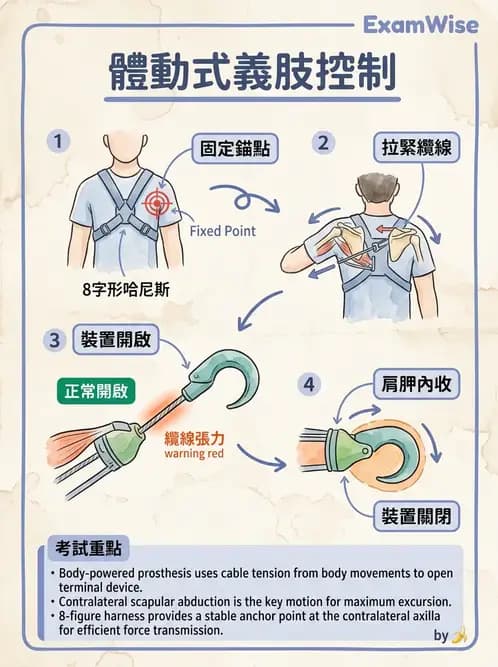
肘下截肢者(below-elbow amputee,又稱 transradial amputee)使用體動式義肢(body-powered prosthesis)時,以纜線(cable)連接肩帶(harness)與末端裝置(terminal device,如手鈎)。纜線的張力由特定肢體動作產生,從而控制末端裝置的開合。理解哪個動作驅動纜線是本題核心。
選項分析
(A) 同側肩關節外轉(shoulder external rotation)
- 外轉動作對纜線產生的張力有限,不是體動式義肢的主要控制動作。
(B) 對側肩關節外展(shoulder abduction)
- 對側肩關節外展可能在特定哈尼斯設計中產生輕微張力,但不是 transradial 義肢末端裝置開啟的標準動作。
(C) 對側肩胛骨外展(scapular abduction)——正確答案
- 體動式 transradial 義肢使用8字形哈尼斯(figure-8 harness),纜線繞過對側腋窩作為錨點。當患者進行**對側肩胛骨外展(biscapular abduction)**或同側肩膀屈曲時,可拉緊纜線張力,打開末端裝置(手鈎)。對側肩胛骨外展是最典型的動作,尤其在靠近身體操作時。
(D) 對側肩胛骨內收(scapular
...(解析預覽)...
升級 VIP 解鎖圖文解析